Harvey Keitel's Path to Hollywood Success

Harvey Keitel isn’t among the most well-known actors who have had issues with stuttering, yet he has never shied away from revealing what a factor stuttering has been throughout his life.
 Harvey Keitel was born in Brooklyn on May 13, 1939, and spent his formative years in that borough’s Brighton Beach neighborhood. His parents were Jewish immigrants, his mother from Romania and his father from Poland. He was the youngest in his family, having an older sister Renee and an older brother Jerry. His parents owned and operated a neighborhood luncheonette, while his father also worked in a hat factory.
Growing up in a strict Orthodox Jewish household, his teenage years presented a problem for him as it was the era of Marlon Brando, James Dean and Elvis Presley. Following his bar mitzvah, he began to reject his Jewish faith and dress like kids who would be perceived as “juvenile delinquents” with the “duck’s ass” hairstyle, the leather jacket, and the peg pants set off by pointy shoes with metal cleats that could announce his arrival from a block away.
Keitel knew that he was not the only kid from Brooklyn who argued with his parents about dressing like a hood. However, his masquerade as a would-be hoodlum came to an abrupt end when he left high school without graduating and at age 17 joined the U.S. Marines where he served as an infantry rifleman from 1956-1959. He was deployed to Lebanon in 1958 during the U.S. intervention known as Operation Blue Bat, which aimed to stabilize the country during political unrest.
Upon his discharge from the Marines, Keitel began a ten-year career as a court stenographer in New York City. It was during this time that he began acting classes on a whim in 1964. The rest is history.
He would study under both Stella Adler and Lee Strasberg, as well as at the HB Studio. Around this time, he was cast in his first movie role, as the star of Martin Scorcese’s first feature film Who’s That Knocking on My Door in 1967, beginning the first of many collaborations with Scorcese. In 1973, he starred in Scorcese’s highly acclaimed film Mean Streets. In 1974 and 1976, he would team up with Scorcese again in Alice Doesn’t Live Here Anymore and Taxi Driver, respectively.
Keitel was originally hired to play Captain Willard in Francis Ford Coppola’s Apocalypse Now, but a few weeks into the shooting, Coppola did not like Keitel’s portrayal and replaced him with Martin Sheen.
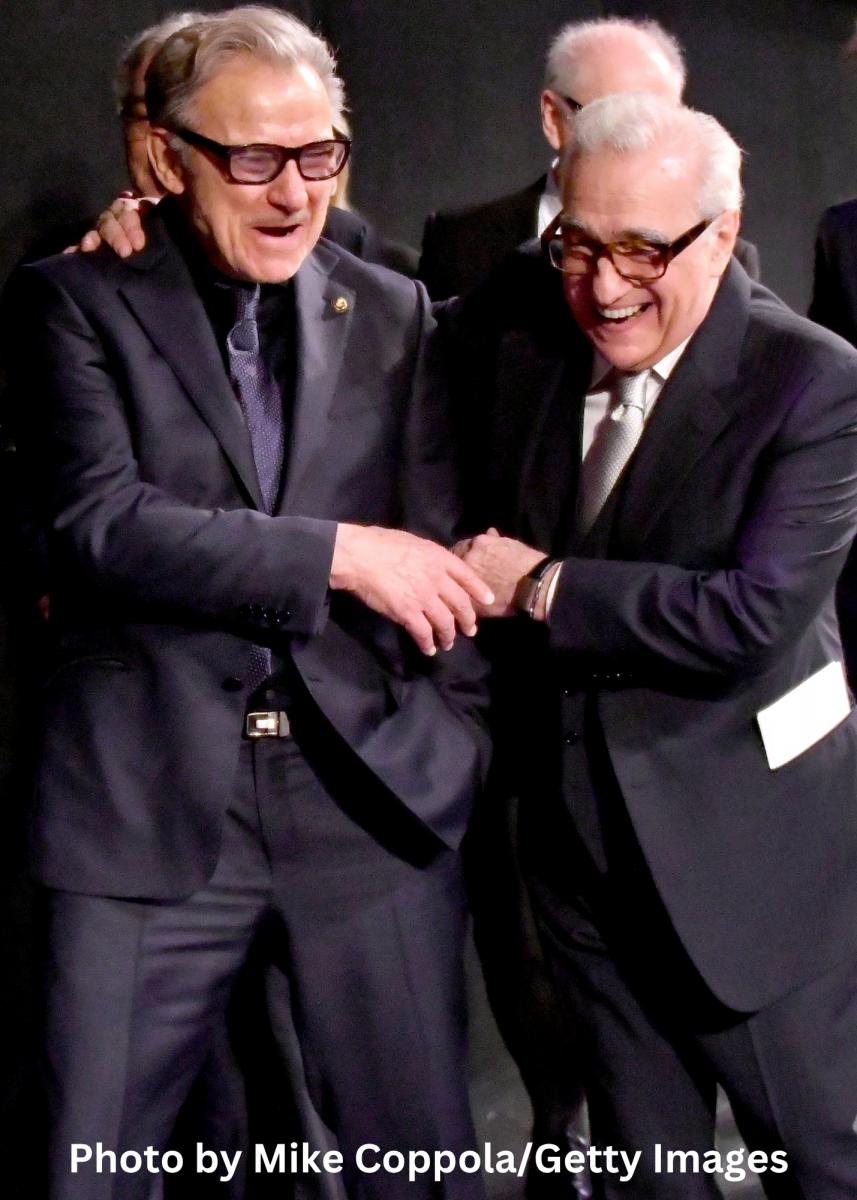 A comprehensive look at Keitel’s career would be a volume in itself, but he has appeared in countless major movies. From 1985-1988, he was one of the busiest actors in Hollywood, appearing in 16 films and television movies. In 1991 he was nominated for an Academy Award for Best Supporting Actor for his role as Mickey Cohen in Bugsy. His high-profile roles over the years are numerous: The Last Temptation of Christ (1988), The Two Jakes (1990), Thelma & Louise (1991), Sister Act (1992), Reservoir Dogs (1992), Bad Lieutenant (1992), The Piano (1993), Clockers (1995), Little Nicky (2000) , U-571(2000), National Treasure (2004) , National Treasure: Book of Secrets (2007), Three Seasons (1999), Holy Smoke! (1999), Taking Sides (2001), The Grey Zone (2001), and The Irishman (2019).
Over the many years of his career, Keitel has not been shy about disclosing his history of stuttering. The biography Harvey Keitel: The Art of Darkness contains a major passage about his speech odyssey:
Home life was something else: ‘I’ve had many problems in my life that I’ve had to get through, beginning with being a little boy,’ Keitel observed.
Such as the fact that he began stuttering at the age of six or seven, a problem that carried on into his teens. What is a painful and emotionally challenging period in anyone’s life became excruciating for a young man who stuttered:
‘It was a huge, huge, deep, deep, embarrassment, the object of humiliation by other children. It took years to go away. I still stutter at times. The stutter is the result of something else. It’s sort of a road to your identity. It’s a clue about something, it’s a clue about disturbance.’
‘It was very painful because I was shy to begin with. Confrontation means asserting yourself. Stuttering is an attempt to stop the assertion of the self. I can’t think of anything more frustrating or more detrimental to evolving than not allowing yourself whatever thought comes to mind.’
In an October 18, 1992, article in the Los Angeles Times, “Leaps of Faith: Harvey Keitel’s Search for God Often Involves Confronting His Darker Self,” Keitel’s stuttering is addressed when the article describes how in 1964, in the fifth year of his 10-year career as a court stenographer, he agreed to a friend’s suggestion that they go for acting lessons. The article stated, “Though Keitel had struggled with a stuttering problem since childhood, he agreed to give it a shot.”
In “Harvey Keitel: What I’ve Learned”, a January 24, 2016, profile in Esquire, the proud native of Brooklyn addressed his stuttering by saying, “When I was a little boy I had a stutter. I still stutter, but much less. Back then it was a real champion stutter. In time it faded away, for the most part. Now it seems to be returning a little bit. Maybe because I’m so fatigued. I don’t mean just now, but in these years.”
Harvey Keitel spoke about his stuttering on national television in an interview on CBS Sunday Morning with co-host Anthony Mason on December 15, 2019. When asked about his “pretty nasty” childhood stutter, Keitel responded, “You can hear it now.” When Anthony Mason said that he could not, he said matter-of-factly, “Then I’m doing a good job of hiding it.” He began, “It was terrible. It was awful. Kids make fun of you; your friends make fun of you – we’re all kids. But it was terrible.”
He continued, “I always wished there was something I could come up with that could help heal young people that do have a bad stutter. I think about it constantly… and the only thing I’ve ever been able to come up with is awareness – trying to become aware – in the literature, in the arts – awareness might help them.”
When Anthony Mason asked the actor how he conquered it, he responded, “I stuttered. I stuttered in the Marine Corps – not as badly as I did as a child… I just stuttered at times. As a child, I stuttered all the time…. in the Marines just rarely. There was no one way I conquered it. It was just … what I am saying now, the best advice I could give as the result of my experience is awareness of yourself.”
He continued with, “Mine slowly went away… if 20, 25 years, slowing going away, and painfully so.” He also contended that stuttering never entered into his acting, “I never stuttered acting, sort of like you hear me now. It never interfered with acting. No, no, no.”
In a September 12, 1995, interview with The Washington Post, Keitel was quoted as saying, “The only true recognition is the work itself. You don’t need to be nominated for an Oscar to be recognized for your work.” This statement by the actor can be viewed as a universal theme as people who stutter navigate the minefields of speech every day in their chosen professions.
Harvey Keitel’s fascinating life from high school rebel to U.S. Marine to court stenographer to famous actor is nothing short of fascinating in light of the fact that he had to manage his speech all along the way. His story is an inspiration to people who stutter to persevere and not to let stuttering hold them back from their aspirations in terms of a profession.
From the Spring 2026 Magazine