


 Podcast
 Sign Up
 Virtual Learning
 Online CEUs
 Streaming Video Library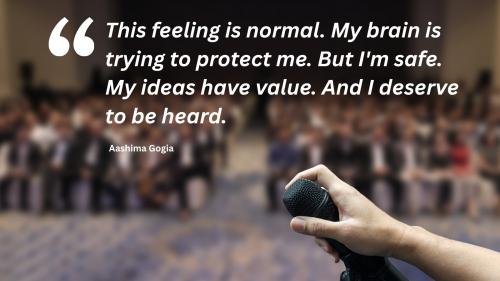
A Blog by Aashima Gogia
April 14, 2026
I stood backstage at a tech conference in New Delhi, about to present on how to grow AI products to 200 people. My slides were ready. My ideas were solid. I'd rehearsed for weeks.
But my hands were shaking. Not because I didn't know my material—because I was convinced that the moment I stuttered on stage, everyone would realize I didn't belong there.
Here's what I've learned: The world doesn't remember your stumbles. It remembers your courage to show up.
I'm Aashima Gogia, a product leader from India. I stutter. And despite leading teams, winning speech competitions, founding support groups for women who stutter, and speaking at conferences about inclusion, I still sometimes feel like a fraud.
That voice in my head whispers: "If you can't get the words out smoothly, maybe you're not really qualified."
That's imposter syndrome. And if you stutter, you probably know this feeling, too.
But I'm done apologizing for taking up space. And you should be too.
Imposter syndrome is when you feel like a fake even after real success. You think your achievements are luck, not skill. You wait for people to "find you out."
When you stutter, this feeling gets amplified. People notice when you speak. They wait.
Sometimes they look away or finish your sentences. Your brain takes that as evidence: "See?
My speech is broken, so I must be broken too."
But here's the truth I'm learning: The stutter is just how the words come out. It's not a measure of what you know or what you're worth.
Your difference isn't your disadvantage. It's your distinction.
Joe Biden became President of the United States. Emily Blunt starred in major films. Ed Sheeran filled stadiums. All of them stutter. They didn't wait for permission to be great. They didn't wait to be "fixed" first. They showed up, exactly as they were, and owned their space.
You can too.
I found help in unexpected places. Currently, I'm reading Big Trust by Dr. Shadé Zahrai's. I used ideas from her work but adapted to my own journey with stuttering. These are simple steps that work for anyone, anywhere. No excuses. No waiting for the "perfect moment." Just action.
Here's how I'm doing that:
1. Accept That This is Normal (And You're Still Capable)
The first step isn't to be fearless—it's to accept that fear and doubt are normal, especially for thoughtful people who see how much they still have to learn.
Look, I'm not going to tell you to "just be confident." That's nonsense. Confidence or self-trust isn't something you summon out of thin air. It's something you build, brick by brick, by showing up for yourself.
What this means is, stop fighting the fact that you stutter. Stop apologizing for it in your head. It's part of how you communicate, not proof you're inadequate.
Every time you speak despite the fear—that's a brick. Every time you share your idea even when the words get stuck—that's a brick. You're building something real.
Try this: When doubt comes ("I'm not good enough because I stutter"), pause and say to yourself:
"This feeling is normal. My brain is trying to protect me. But I'm safe. My ideas have value. And I deserve to be heard."
I keep a note on my phone with three things I did well each week. Last week: "Explained the new feature roadmap clearly in standup, even with blocks. The team understood and asked good questions." When I feel low, I read it. This is real evidence, not fake confidence.
Your wins count. All of them. Even the small ones. Especially the small ones.
2. Take Small Steps Forward (Done Beats Perfect)
Perfectionism kills action. If you wait until you can speak "perfectly" before sharing ideas, you'll never speak.
And let me be clear: the world needs your ideas more than it needs your perfect delivery.
I learned a simple trick: Before important meetings, when you are with yourself, say 'close enough' out loud. It releases the pressure. It reminds you that good enough is actually... "good enough".
What this means is, you don't need fluent speech to contribute. You need to show up and share your perspective. That's it. That's the whole job.
Try this: Before your next meeting or call, tell yourself: "I'm close enough to share my idea." Then speak. Messy contribution beats silent perfection every single time.
I practiced my conference presentation with friends who knew I stutter. I didn't aim for smooth, I aimed for clear. Some words stuck, but my message landed. That built trust that I could handle the real stage.
And here's what nobody tells you, when you embrace your imperfections, you give others permission to embrace theirs too. That's true leadership.
3. Stop Comparing Your Journey to Others
Comparison is poison when you stutter. "Others speak smoothly, I don't" becomes "Others are better than me."
Stop it. Right now.
Your journey is yours. Their journey is theirs. You're not running the same race, so why are you checking their lane?
What this means, your path is different, yes. But different doesn't mean less. The effort you put into communication? It builds empathy, resilience, and strength that others might never develop. Those are superpowers, not setbacks.
Try this: Create a "Confidence Bank"—a folder on your phone or email where you save positive feedback, moments you helped someone, or times you succeeded.
When imposter thoughts hit, open it. Facts beat feelings, every time.
I have an email folder called "Real Evidence." It has messages from mentees I've helped, feedback from my manager on a successful product launch, and a photo of me at that speech competition I won. When I doubt myself, I look. The proof is right there.
You have proof too. Start collecting it. Own your wins without shrinking them.
4. Feel the Fear and Move Anyway
Anxiety before speaking is normal. Blocks happen. The goal isn't to eliminate fear—it's to act despite it.
Courage isn't the absence of fear. It's walking forward anyway.
When I feel panic rising before a call, I don't try to crush it. I acknowledge it: "This is my brain doing its job, trying to keep me safe. But I'm actually safe. I can speak anyway."
Then I take one tiny action: I unmute. I start the first word. That's all it takes to begin.
Try this: When a block happens, pause, breathe, and continue. That small act tells your nervous system "I'm okay." Over time, the fear gets smaller. The trust grows bigger.
I use tools that help me—sometimes I slow down, sometimes I breathe before difficult words, sometimes I go for meditation or therapy. But I've learned the goal isn't perfect fluency. The goal is connection. And I can connect.
Your voice is enough. You are enough. Right now. As you are.
You don't build confidence by pretending to be fearless. You earn it by showing up even when you're afraid.
If you stutter and feel like an imposter, listen to me: You're not alone. And you're not faking it. You're real, you're capable, and you're growing.
That presentation in New Delhi? I stuttered during it. Several times. And you know what happened? People came up afterward to discuss my ideas. They remembered my insights, not my blocks. They saw my substance, not my pauses.
Because that's what happens when you stop shrinking yourself. People finally see you for who you really are.
Start small today:
- Say "close enough" before your next conversation
- Add one win to your Confidence Bank
- Speak up once in a meeting, even if the words don't flow smoothly
Your voice matters—even when it takes time to come out. Your ideas are valuable—even when they arrive with effort. You belong at every table you sit at—even when your seat feels shaky.
The world is waiting for what you have to say. Don't make it wait any longer.
Let's keep going, one word at a time. One brave moment at a time.
Because we're not just people who stutter. We're people who show up. We're people who persist. We're people who refuse to let our voices be silenced by our own doubt.
And that? That's everything.